

Brussels — Zero Waste Europe (ZWE) is calling for a structural overhaul of Extended Producer Responsibility (EPR) schemes across the European Union, arguing that current systems are overly focused on downstream waste management and insufficiently support waste prevention, reuse, and repair.
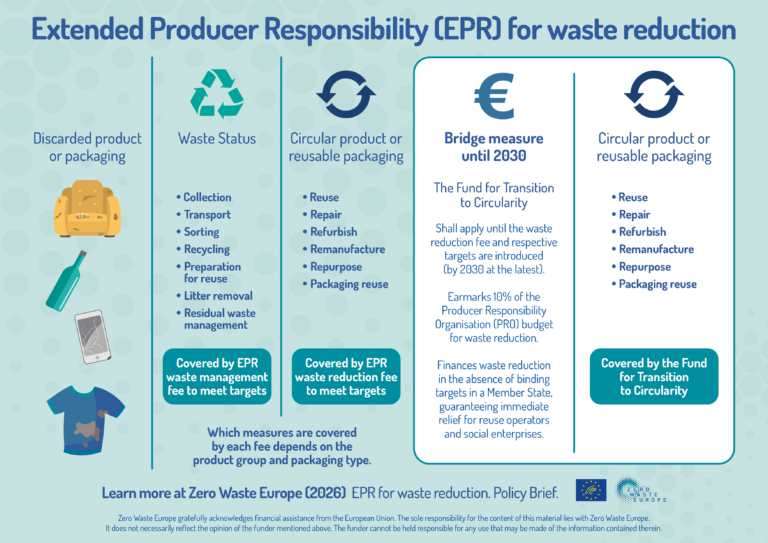
In a new policy brief released February 17, the environmental network proposes that producer fees under EPR be divided into two distinct budgets: one for waste management and another specifically earmarked for waste reduction.
Under the proposed framework, waste management fees would continue to cover the costs of collection, sorting, and recycling required to meet existing targets. A newly defined waste reduction fee would instead finance repair networks, reuse infrastructure, refurbishment programs, and other prevention-focused measures.
“The waste reduction fee should cover, for example, the budget necessary to achieve waste reduction targets, via reuse, repair, refurbishment and similar measures,” commented Theresa Mörsen, Waste & Resources Policy Manager at ZWE
Addressing Europe’s Stagnating Circularity Rate
ZWE frames the proposal as a response to the EU’s stagnating circular material use rate. The EU has set a target of reaching 22.4% circularity by 2030; however, the rate stood at 12.2% in 2024. At the same time, several waste streams, including packaging, continue to grow.
The organization argues that without redirecting funding upstream toward reduction and reuse systems, meeting the EU’s circularity objectives will be difficult.
Interim “Transition to Circularity” Fund
ZWE acknowledges that in many Member States, reliable data on the costs of reuse and reduction systems remains limited. As a result, it proposes a transitional measure running until 2030: a mandatory “fund for the transition to circularity.”
Under this interim mechanism, a minimum percentage of Producer Responsibility Organisation (PRO) budgets would be ring-fenced specifically for reduction and reuse initiatives. The fund would operate as a bridge while better cost data and performance benchmarks are developed.
“Most of the initiatives to boost reuse and repair today, be it repair vouchers or local reusable packaging systems, are financed by the public budget,” Mörsen said. “As treasuries are increasingly under pressure, producers must, in line with the Polluter Pays Principle, bear a greater share of the costs of the transition to circularity. The general mindset is still pretty much stuck with protecting outdated linear business models instead of helping new ones to thrive.”
Governance and Accountability
Beyond restructuring fees, ZWE calls for stronger governance rules within EPR systems. These include legally binding targets for PROs, transparent reporting on how funds are allocated, and clear oversight mechanisms to ensure financing reaches circular business models.
The proposal aligns closely with the EU Packaging and Packaging Waste Regulation (PPWR), which introduces reuse and waste reduction targets beginning later this decade. ZWE argues that EPR schemes should play a more direct role in financing the infrastructure required to meet those obligations, including reuse systems, reverse logistics, and washing operations.
As discussions advance around the forthcoming Circular Economy Act, the question of whether EPR should remain focused on waste management or evolve into a broader financing mechanism for circular business models is likely to become a central policy debate.
Read the brief from Zero Waste Europe.

Rick LeBlanc, EMBA, is the founder and editor of Reusable Packaging News (subscribe to the free newsletter) and editor of Western Pallet Magazine. A supply chain journalist with more than 30 years of experience, he specializes in pallets, reusable packaging, material handling and related operations. Rick is co-author of Pallets: A North American Perspective and Pallets & Progress: A Collected History of Pallets and Palletized Handling 1922–1945. He is also an advisory board member of the Virginia Tech Center for Packaging and Unit Load Design. Read Rick’s full bio.


